
In brief
With China controlling 90% of rare earth refining, Australia aims to bolster its position in the market while facing challenges in the supply chain.
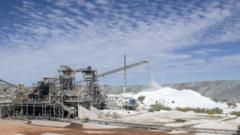
China's recent decision to halt exports of rare earth elements has triggered widespread alarm in the global market, prompting Australia's Prime Minister Anthony Albanese to make a bold commitment ahead of next month's election. Albanese has pledged to invest A$1.2 billion (£580 million) into a strategic reserve for critical minerals, a move aimed at enhancing Australia’s position in international trade amid escalating tensions with China.The timing of this proposal is critical, as China imposed restrictions on the export of seven rare earth elements—integral for advanced technologies ranging from electric vehicles and advanced weaponry to robotics. These controls are perceived as a direct response to the tariffs levied by the Trump administration on Chinese imports, which currently stand at an impressive 145%. Highlighting the Australian government’s strategy, Albanese assured the prioritization of minerals that are essential for national security and its allies. However, experts are questioning whether this move could effectively challenge China's substantial grip on the rare earth market. Rare earths consist of a group of 17 elements, renowned for their complexity in extraction and refinement processes, with key components like samarium and terbium poised to be pivotal in future technological advancements.In recent years, China has established a near-monopoly on the refining of rare earth minerals, controlling 90% of the process. Despite both Australia and China holding significant reserves of rare earths, the majority of global processing takes place in China. This has raised alarms within Western governments about their reliance on Chinese resources, exacerbated by the U.S. and EU's past neglect of the critical minerals sector.Several analysts, including Philip Kirchlechner from Iron Ore Research in Perth, echo concerns that the U.S. and EU have been complacent, resulting in China's overwhelming control over the market. The monopoly is underscored by statistics indicating that 75% of U.S. rare earth imports came from China between 2019 and 2022.Elon Musk, CEO of Tesla, cited these export controls as a significant impediment to the development of their humanoid robots, further illustrating how China’s actions affect major players in the tech industry.Albanese's strategic reserve aims to ensure that critical minerals will be available to both domestic industries and international partners, likely encouraging trade with allies such as the U.S. and EU. However, experts caution that even a ramp-up of Australian supplies will not fundamentally alter the landscape of rare earth production, given China’s dominance in refining.Australia boasts substantial mining capabilities, with 33% of global lithium production emerging from its mines. Despite this, the country only refines a minimal fraction of its lithium exports, in stark contrast to China's capacity, which allows it to exert significant influence over global pricing and supply. Australia’s recent investments include the establishment of the nation’s first combined mine and refinery for rare earths, set in Perth, and the opening of a processing plant operated by Lynas Rare Earths. Nevertheless, projections indicate that Australia will still depend heavily on Chinese refining capabilities until at least 2026.As the geopolitical landscape shifts, Beijing's editorial responses have been critical of the U.S.'s global trade pattern, urging Australia to collaborate with China—a call that Albanese swiftly rejected. The strategic significance of Albanese's plan is apparent, offering a pathway to protect Australia and its allies from adversarial pressures stemming from China’s tactics.Leading economists note that while the proposal is sophisticated in its outlook, it cannot entirely detach Australia from China's refining monopoly. Any attempt to reinforce ties with Western partners, particularly the U.S., must recognize existing vulnerabilities that China could exploit in the global market.In summary, while Australia's move to invest in key minerals may bolster its international negotiating power, the overarching reliance on China for refining capabilities remains a significant obstacle in the pursuit of independence within the critical minerals market.