The US has proposed Ukraine withdraw from the eastern Donetsk region and create a 'special economic zone' in the areas it currently controls, Ukrainian President Volodymyr Zelensky has said.
Zelensky stated that territory and control of the Zaporizhzhia nuclear power plant remain the two main unresolved issues in the peace plan proposal for Ukraine.
In a sobering briefing to reporters, Zelensky addressed the US desire for a quick end to the conflict, the complex nature of the ongoing negotiations, and his belief that Russia had no desire to stop the war.
Ukraine has sent the US an updated 20-point plan plus separate documents regarding security guarantees and provisions for Ukraine's reconstruction, according to Zelensky.
This follows weeks of high-level diplomatic activity with several peace plans drawn up, adjusted, and revised by US, Ukrainian, Russian, and European leaders.
The Ukrainian leader remarked, 'The final mile is the hardest. Everything could fall apart for many reasons.'
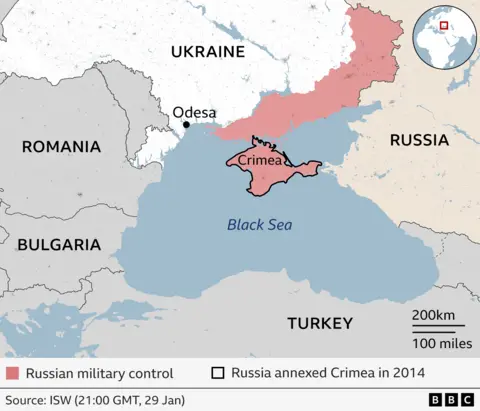
Russia demands that Ukraine relinquish control of roughly 30% of the eastern Donetsk region it still holds, something Ukraine has refused to do on principle, fearing it would allow Moscow a foothold for future invasions.
Zelensky mentioned that the US is envisaging a solution where Ukrainian forces would withdraw from parts of Donetsk, with Russian forces committing to not advancing into the territory, establishing a 'special economic zone' or a 'demilitarised zone.'
However, he stressed that it would not be fair for Ukrainians to withdraw unilaterally and proposed that Russia should also pull back by the same distance, raising concerns about how to prevent Russian infiltration following any withdrawal.
Zelensky voiced his 'very serious concerns' and highlighted that Ukraine might not accept the proposal at all, yet he opened the door to the possibility of elections or a referendum to give the Ukrainian people a choice.
He acknowledged that the ongoing fighting could significantly influence future negotiations, citing the performance of Ukrainian military forces as a crucial factor.
Another contentious issue involves the management of the Zaporizhzhia nuclear power plant, which has been under Russian control since March 2022. Zelensky suggested a possible solution involving a joint control arrangement between the Russians and the Americans, although he admitted the details would need clarification and doubted Moscow's willingness to agree.
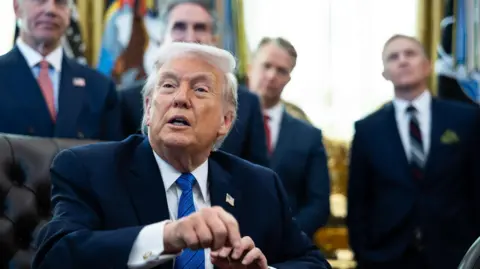
Amid frustrations within the US, President Donald Trump appears eager for a quicker resolution, worrying Kyiv and its allies about potential pressure to accept a compromise favoring Russia.
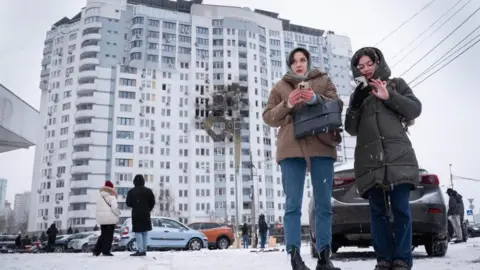
Zelensky reported that although the US is pushing for a rapid conclusion to the conflict, no deadlines are set for reaching an agreement. Ukraine, currently facing frequent aerial attacks, seeks an immediate ceasefire as a precursor to a more detailed peace resolution.
Russia, on the other hand, may benefit from delaying a ceasefire as its troops continue to gain ground on the frontlines. 'After multiple rounds of talks with Russia,' Zelensky noted, 'the Americans now appear aligned with Moscow on this position.'
Kremlin officials have been tight-lipped about negotiations, but Russia has been attempting to project a unified stance with Washington. Foreign Minister Sergei Lavrov has praised Trump's efforts to broker a deal and noted meetings with US envoys have 'eliminated' misunderstandings between the two sides.
Despite this, Ukraine and Europe remain skeptical of any promises from Moscow, given previous violations of ceasefires. There is a call for US involvement in ensuring Ukraine's security to prevent future attacks.
Zelensky mentioned receiving drafts of US security guarantees, acknowledging they are still a work in progress, and expressed that they may not fully meet Kyiv's security needs. He indicated that the US's stance on NATO membership for Ukraine remains unyielding, further complicating the dialogue.
Zelensky advised caution, underlining the uncertainty surrounding US-Russia agreements while recognizing that US support for Ukraine could eventually wane, impacting arms supplies and intelligence sharing.
Expressing the precariousness of the talks, he concluded, 'No one knows what may happen the day after tomorrow... We do not know how these negotiations will end.'