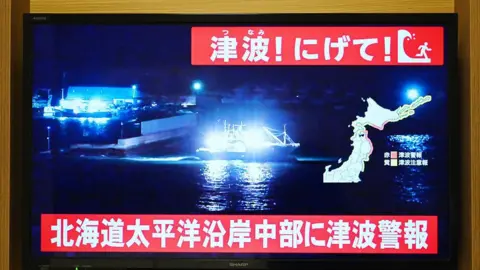
A major earthquake of magnitude 7.6 has hit Japan's north-eastern region. The quake occurred at 23:15 (14:15 GMT) at a depth of 50km (31 miles), about 80km off the coast of the Aomori region, as reported by the Japan Meteorological Agency. Initially prompting tsunami warnings, these have now been downgraded to advisories, with some areas experiencing wave heights of 40cm (16in).
Local media reports indicate that some individuals in the affected region have sustained injuries, while train services have been temporarily suspended as a precaution. Japan, one of the most earthquake-prone nations globally, typically experiences seismic activity every few minutes, making its rigid preparedness systems critical.
In response to the earthquake, orders were issued for approximately 90,000 residents to evacuate. Officials from Japanese public broadcaster NHK reported injuries from a hotel employee in Hachinohe. The government has established a response office within the prime minister's crisis management center, deploying an emergency team, as stated by chief cabinet secretary Minoru Kihara. We are making every effort to assess the damage and implement emergency disaster response measures, including rescue and relief operations, he emphasized.
Fortunately, Tohoku Electric Power indicated that there were no irregularities reported at the Higashidori and Onagawa nuclear power plants due to the quake. The authorities confirmed that none were detected at the decommissioned Fukushima nuclear power station site as well, following checks by the International Atomic Energy Agency. The Fukushima site was previously devastated during a magnitude 9.0 quake on March 11, 2011, which caused a catastrophic tsunami, claiming over 18,000 lives and obliterating numerous communities.
As the situation continues to develop, authorities remain alert and engaged in monitoring and responding to this seismically active region.
Local media reports indicate that some individuals in the affected region have sustained injuries, while train services have been temporarily suspended as a precaution. Japan, one of the most earthquake-prone nations globally, typically experiences seismic activity every few minutes, making its rigid preparedness systems critical.
In response to the earthquake, orders were issued for approximately 90,000 residents to evacuate. Officials from Japanese public broadcaster NHK reported injuries from a hotel employee in Hachinohe. The government has established a response office within the prime minister's crisis management center, deploying an emergency team, as stated by chief cabinet secretary Minoru Kihara. We are making every effort to assess the damage and implement emergency disaster response measures, including rescue and relief operations, he emphasized.
Fortunately, Tohoku Electric Power indicated that there were no irregularities reported at the Higashidori and Onagawa nuclear power plants due to the quake. The authorities confirmed that none were detected at the decommissioned Fukushima nuclear power station site as well, following checks by the International Atomic Energy Agency. The Fukushima site was previously devastated during a magnitude 9.0 quake on March 11, 2011, which caused a catastrophic tsunami, claiming over 18,000 lives and obliterating numerous communities.
As the situation continues to develop, authorities remain alert and engaged in monitoring and responding to this seismically active region.