Early reports indicate that the pilot of a US F-15 fighter aircraft downed over Iran was rescued - which, if confirmed, would be the latest in the long history of US combat search-and-rescue missions over decades.
According to CBS, the BBC's US partner, the search operation is ongoing deep inside Iran for a second crew member.
Combat search and rescue, or CSAR, missions are considered among the most complex, time-sensitive operations that US and allied militaries prepare for. In the US, elite units of the Air Force are specially trained for CSAR missions and are often pre-emptively deployed near conflict areas where aircraft could be lost.
What is Combat Search and Rescue?
Put simply, CSAR missions are military operations aimed at finding, aiding and potentially rescuing personnel in need, including downed pilots and isolated troops. In contrast to conventional search-and-rescue efforts - which could take place during humanitarian operations or after disasters - CSAR missions occur in hostile or contested environments.
In some cases - as in Friday's reported recovery effort in Iran - the operations may happen deep in enemy territory. The missions are extremely time-sensitive, as enemy forces would likely be deployed in the same area to try and locate the same US personnel the CSAR teams are trying to rescue. In modern times, CSAR missions are often conducted by helicopters, with refueling aircraft in support and other military aircraft on hand to conduct strikes and patrol the area.
Notably, verified video that emerged from Iran on Friday appeared to show US military helicopters and at least one refueling aircraft operating over Iran's Khuzestan province.
The history of CSAR missions
Airborne, wartime rescue missions have a long history, dating back to First World War pilots conducting impromptu landings in France to rescue downed colleagues. The US military's Pararescue units trace their lineage back to a 1943 mission in which two combat surgeons parachuted into then-Burma - now officially Myanmar - to help wounded soldiers. The world's first helicopter rescue took place a year later, when a US lieutenant rescued four soldiers from behind Japanese lines, according to Smithsonians Air & Space Magazine. The incident also marked the first operational use of a helicopter in combat.
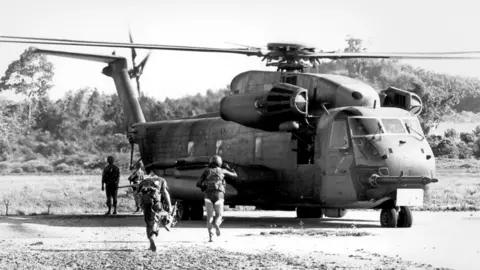
Formal search-and rescue-units were first established in the US in the immediate aftermath of the conflict. But modern CSAR began during the Vietnam War. One mission, known as Bat 21, led to the loss of several aircraft and multiple American casualties while attempting to recover the pilot of an aircraft shot down behind North Vietnamese lines. The war required a vast expansion of CSAR missions with increased scope and complexity. The experience helped the military refine tactics and procedures that have helped form the foundation of rescue operations since.
The US Air Force's Pararescue teams
While each US military branch has their own limited CSAR capabilities, the US Air Force has the primary responsibility for finding and rescuing military personnel. This work is primarily conducted by what are known as Pararescuemen, part of the military's broader special-operations community. The official Pararescue motto is These Things We Do, That Others May Live, and their work is considered part of a broader promise to US servicemembers that they will not be left behind. These personnel are highly trained as both combatants and paramedics, and go through what is widely considered one of the hardest selection and training pipelines in the US military.
The selection-and-training process - which takes approximately two years from start to finish - includes parachute and dive training, as well as basic underwater demolition, survival, resistance and escape training and a full civilian paramedic course. They also received specialised courses in battlefield medicine, complex recovery operations and weapons. Historically, about 80% of potential Pararescuemen wash out of the course, although it is often more, according to military news site Sofrep. On the ground, these teams are led by specialised Combat Rescue Officers, who are fully trained Pararescue operators responsible for planning, coordinating and executing the recovery missions.
Recent US rescue missions
Pararescue teams deployed extensively throughout the wars in Iraq and Afghanistan, conducting thousands of missions to rescue US and allied troops that were wounded or required extraction. In 2005, for example, Air Force Pararescue teams were involved to recover a US Navy Seal who was wounded and seeking shelter in an Afghan village after his team was ambushed and its other three members killed - an incident later made into the film Lone Survivor.
Missions to recover downed US pilots have been rare in recent decades. In 1999, the pilot of an F-117 stealth fighter shot down over Serbia was found and recovered by Pararescuemen. In an highly publicised incident in Bosnia in 1995, US pilot Scott O'Grady was rescued in a joint Air Force and Marine Corps CSAR mission after being shot down and evading capture for six days.